
Core Exercises at Home for a Flat Stomach: A Simple Routine That Actually Works
If you want a flatter-looking stomach, you don’t need a gym membership, expensive equipment, or hundreds of crunches every day.
The best core exercises at home for a flat stomach are simple movements that strengthen your abs, improve stability, and help you build a stronger midsection. When combined with regular movement and balanced eating, they can become a realistic part of your weight-loss or fitness routine.
One important thing to know: ab exercises alone cannot specifically burn belly fat. You can strengthen and tone your abdominal muscles, but losing excess body fat happens through overall lifestyle habits rather than trying to burn fat from one specific area.
The good news is that you can work your core effectively right in your living room.
Key Takeaways
- You don’t need equipment to build a stronger core at home.
- Core exercises can strengthen and define your abdominal muscles, but they cannot specifically target belly fat.
- A combination of core training, walking or cardio, strength training, sleep, and balanced nutrition works better than endless crunches.
- Consistency matters more than doing an intense ab workout once in a while.
- Beginners can start with 10–15 minutes of core exercises several times a week.
Can Core Exercises Give You a Flat Stomach?
This is one of the most common questions people ask.
The short answer is: core exercises can strengthen your abdominal muscles, but they don’t directly burn belly fat.
Your body decides where it stores and loses fat based on factors such as genetics, hormones, age, activity levels, and overall energy balance. Doing 100 crunches doesn’t tell your body to take fat specifically from your stomach.
Still, core training is absolutely worth doing.
A stronger core can improve posture, stability, balance, and how you perform everyday activities. As your abdominal muscles become stronger, your midsection may also look firmer.
For a flatter-looking stomach, think beyond ab exercises.
A realistic approach includes:
- Regular core workouts
- Full-body strength training
- Walking or other enjoyable cardio
- A balanced, protein-rich diet
- Plenty of fiber-rich foods
- Adequate sleep
- Consistent portions
- Patience and realistic expectations
You don’t have to do everything perfectly.
The goal is to create habits you can actually maintain.
Best Core Exercises at Home for a Flat Stomach
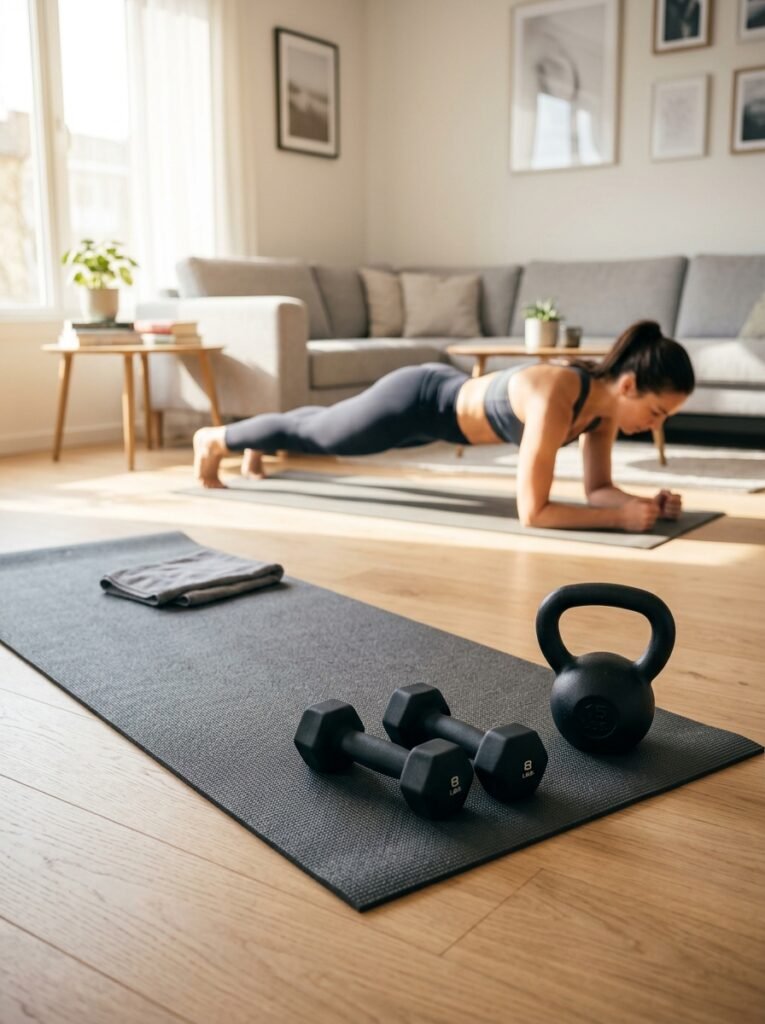
You can train your core without a single piece of equipment.
The following exercises work different parts of your core, including the rectus abdominis, transverse abdominis, obliques, and muscles around your hips and lower back.
Start slowly and focus on controlled movement rather than trying to complete as many repetitions as possible.
1. Dead Bug
The dead bug is one of my favorite beginner-friendly core exercises because it teaches you how to keep your core engaged while moving your arms and legs.
It may look easy, but when performed correctly, you’ll feel your abdominal muscles working.
How to do it:
- Lie on your back with your knees bent at 90 degrees.
- Lift your feet so your shins are parallel to the floor.
- Extend your arms toward the ceiling.
- Gently tighten your stomach.
- Slowly lower your right arm and left leg toward the floor.
- Return to the starting position.
- Repeat on the opposite side.
Try 8–12 repetitions per side.
Keep your lower back gently pressed toward the floor. If your back starts arching, make the movement smaller.
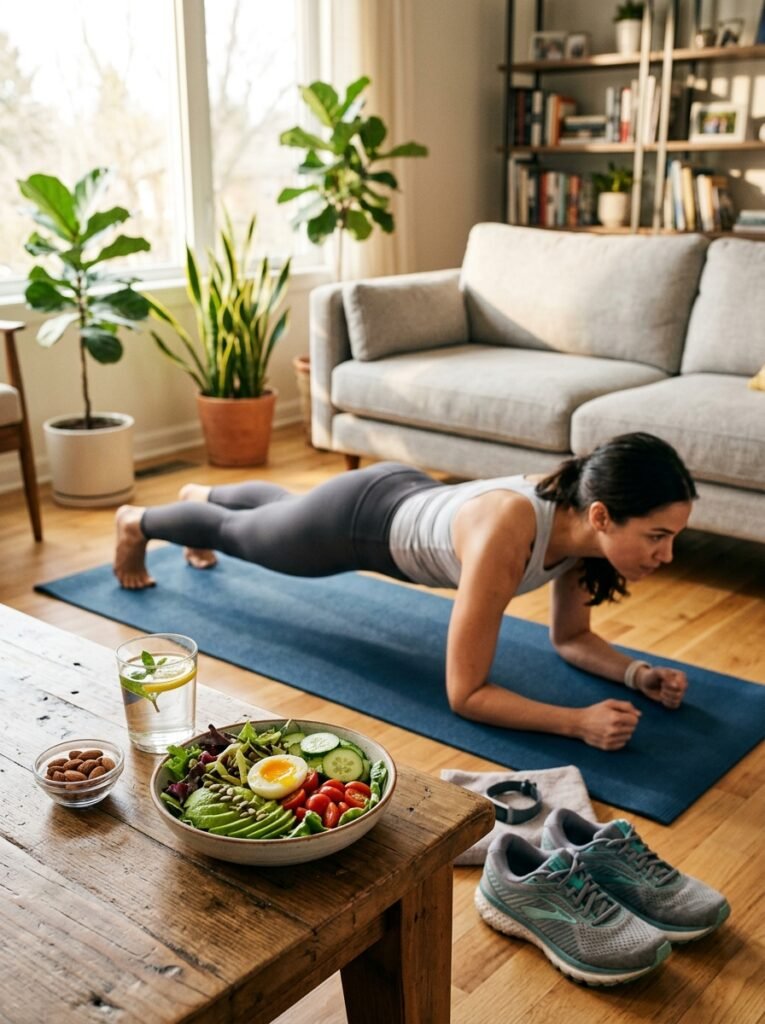
2. Forearm Plank
The plank is a classic for a reason.
Instead of repeatedly bending your spine, you’re teaching your core to resist movement while your entire body stays stable.
How to do it:
- Place your forearms on the floor.
- Extend your legs behind you.
- Keep your body in a straight line from your head to your heels.
- Tighten your abdominal muscles.
- Keep your hips from dropping or lifting too high.
- Breathe normally.
Start with 15–30 seconds.
As you become stronger, gradually work toward 45–60 seconds.
You don’t need to hold a plank for several minutes to get results. Good form matters much more than an impressive timer.
3. Bird Dog
Bird dogs are excellent if you want a core exercise that also challenges balance and coordination.
They are particularly useful for learning how to stabilize your torso while your limbs move.
How to do it:
- Start on your hands and knees.
- Place your hands under your shoulders.
- Position your knees under your hips.
- Tighten your stomach gently.
- Extend your right arm and left leg.
- Pause briefly.
- Return to the starting position.
- Switch sides.
Aim for 8–12 repetitions per side.
Try not to rotate your hips as you extend your leg.
4. Reverse Crunch
If traditional crunches bother your neck, reverse crunches can be a useful alternative.
This exercise emphasizes controlled movement of the pelvis while your abdominal muscles work to bring your knees toward your torso.
How to do it:
- Lie on your back.
- Bend your knees.
- Keep your feet slightly off the floor.
- Bring your knees toward your chest.
- Gently curl your hips off the floor.
- Lower yourself slowly.
Perform 8–15 repetitions.
Avoid swinging your legs. The slower you perform the movement, the easier it is to maintain control.
5. Glute Bridge
A flat-stomach routine shouldn’t focus only on your abs.
Your core works closely with your hips and glutes, so strengthening the muscles around your pelvis can make your overall movement stronger and more stable.
How to do it:
- Lie on your back.
- Bend your knees and place your feet flat on the floor.
- Keep your feet about hip-width apart.
- Tighten your core.
- Push through your feet.
- Lift your hips toward the ceiling.
- Pause briefly at the top.
- Lower your hips slowly.
Try 10–15 repetitions.
Don’t overarch your lower back at the top. Think about squeezing your glutes rather than simply pushing your stomach upward.
6. Heel Taps
Heel taps are a simple way to challenge your abdominal muscles without complicated equipment.
They can also be modified easily for beginners.
How to do it:
- Lie on your back.
- Bend your knees and lift your feet.
- Keep your knees bent.
- Slowly lower one foot toward the floor.
- Tap the floor lightly.
- Bring it back up.
- Repeat with the other foot.
Try 10–15 repetitions per side.
If your lower back begins lifting away from the floor, reduce the range of motion.
7. Bicycle Crunches
Bicycle crunches can challenge both your abdominal muscles and obliques.
However, they are often performed too quickly.
Slow down and focus on bringing your torso and opposite knee together instead of simply moving your elbows as fast as possible.
How to do it:
- Lie on your back.
- Place your hands lightly behind your head.
- Lift your shoulders slightly.
- Bring one knee toward your chest.
- Rotate your torso gently toward that knee.
- Extend the opposite leg.
- Switch sides.
Try 8–12 repetitions per side.
Don’t pull your head forward with your hands. Your abdominal muscles should control the movement.
8. Mountain Climbers
Mountain climbers combine core stability with a cardiovascular challenge.
They’re useful when you want your home workout to feel a little more active.
How to do it:
- Start in a high plank.
- Place your hands underneath your shoulders.
- Keep your body stable.
- Bring one knee toward your chest.
- Return it to the starting position.
- Bring the opposite knee forward.
- Continue alternating.
Start with 20–30 seconds.
You don’t need to sprint. Beginners can perform slow mountain climbers while concentrating on keeping their hips controlled.
9. Side Plank
The side plank is especially useful for challenging the muscles along the sides of your torso.
It can be difficult at first, so don’t feel bad about modifying it.
How to do it:
- Lie on your side.
- Place your elbow underneath your shoulder.
- Bend your knees for an easier version.
- Lift your hips from the floor.
- Keep your torso stable.
- Hold the position.
- Switch sides.
Start with 15–20 seconds per side.
As you improve, straighten your legs and gradually increase the hold time.
10. Plank Shoulder Taps
This exercise adds movement to a traditional plank.
The challenge isn’t simply touching your shoulders. It’s keeping your hips from rocking from side to side.
How to do it:
- Start in a high plank.
- Place your feet slightly wider than hip-width apart.
- Tighten your core.
- Lift one hand and tap the opposite shoulder.
- Put your hand back down.
- Switch sides.
- Continue slowly.
Try 8–12 taps per side.
If your hips move excessively, widen your feet or perform the exercise from your knees.
A 15-Minute Core Workout You Can Do at Home
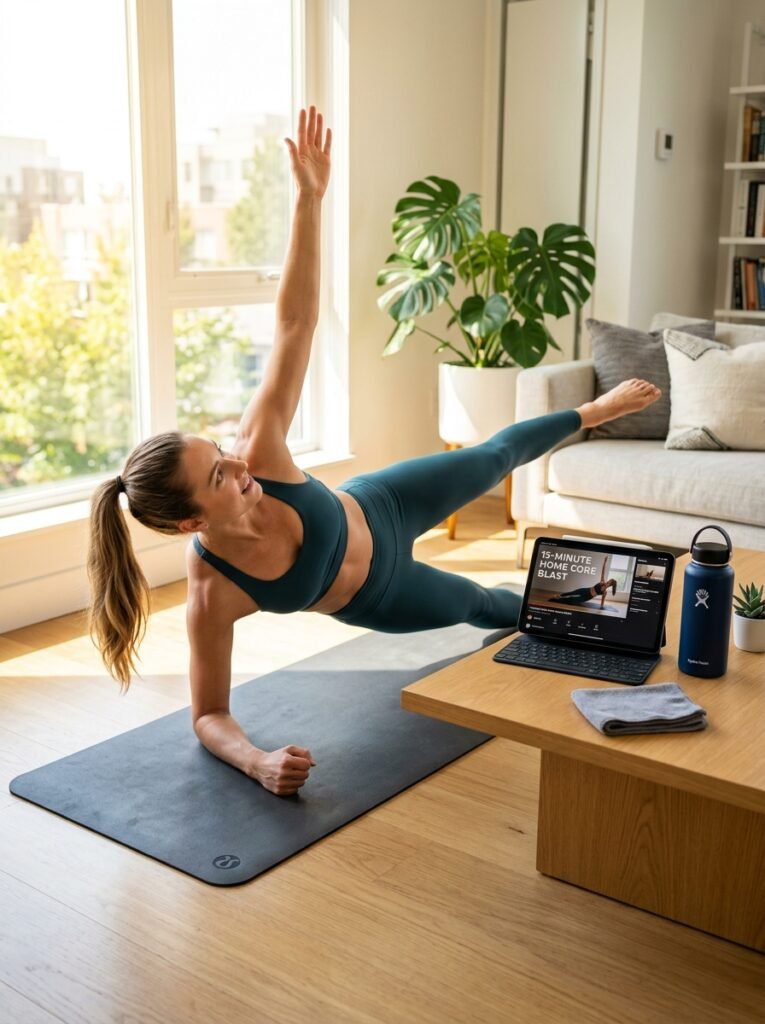
You don’t need to spend 45 minutes doing abdominal exercises.
If you’re short on time, this simple routine can fit into a busy day.
Warm-Up: 3 Minutes
Start with:
- Marching in place for 60 seconds
- Arm circles for 30 seconds
- Gentle torso rotations for 30 seconds
- Bodyweight good mornings for 30 seconds
- Easy step-touch movements for 30 seconds
The goal is simply to get your body moving.
Main Workout: 10 Minutes
Perform each exercise for approximately 40 seconds, followed by 20 seconds of rest.
Complete two rounds.
- Dead bugs
- Forearm plank
- Glute bridges
- Bird dogs
- Mountain climbers
If you’re a beginner, use 30 seconds of work and 30 seconds of rest.
If the workout feels too easy after several weeks, you can increase the work period or add a third round.
Cool Down: 2 Minutes
Finish with gentle movements.
Try slow breathing, an easy child’s pose, gentle torso stretches, or simply walking around the room for a minute.
There’s no need to force a deep stretch.
Beginner Core Workout Schedule
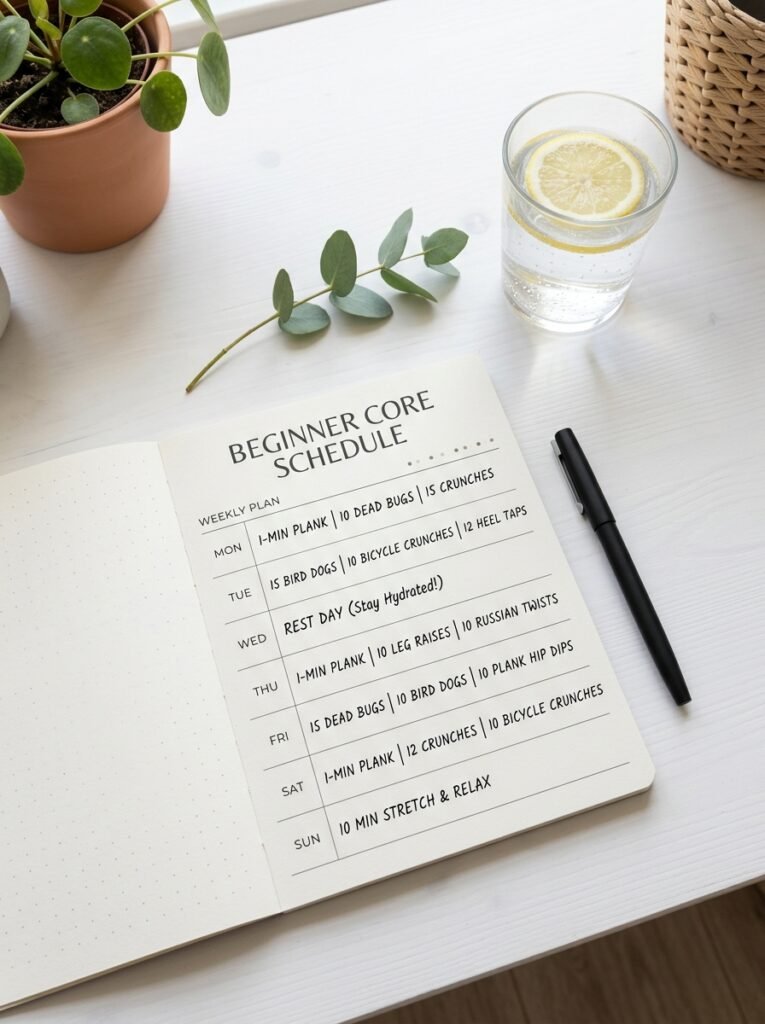
You don’t need to train your abs every day.
For most beginners, 2–4 core sessions per week can be a practical starting point.
Here’s one example:
| Day | Activity |
|---|---|
| Monday | 15-minute core workout |
| Tuesday | Walking or light cardio |
| Wednesday | Rest or gentle movement |
| Thursday | 15-minute core workout |
| Friday | Full-body strength workout |
| Saturday | Walking or another enjoyable activity |
| Sunday | Rest |
Your exact schedule can be different.
If you’re already active, you can incorporate core exercises into your existing strength workouts instead of creating separate ab sessions.
How Often Should You Do Core Exercises?
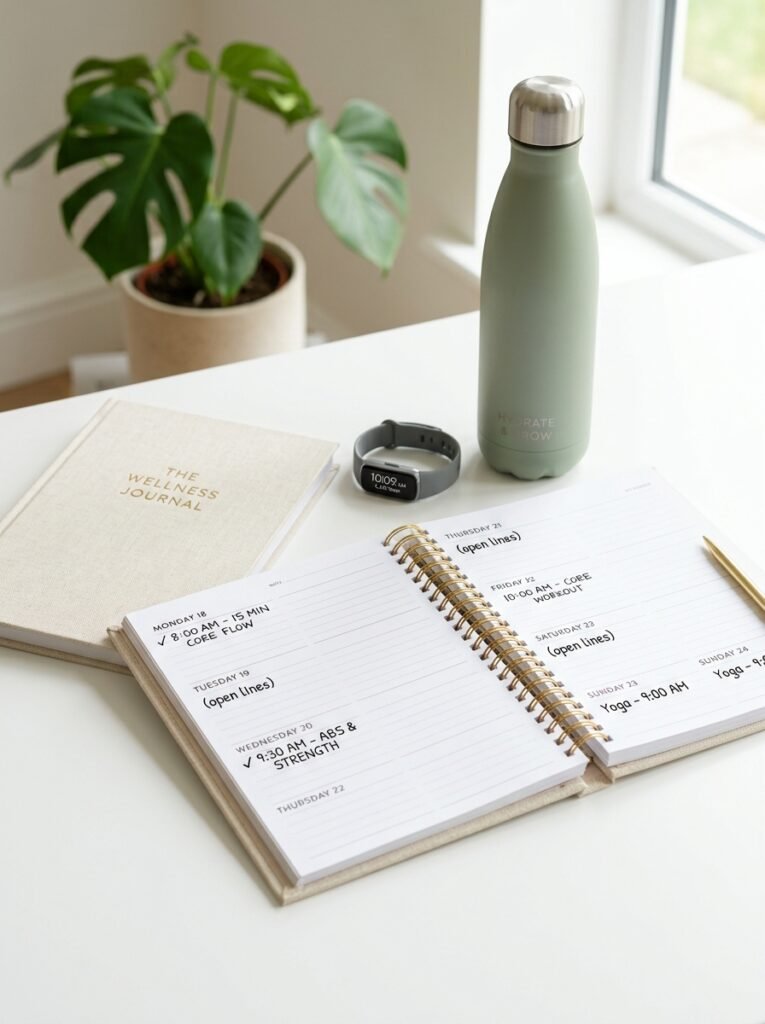
More isn’t automatically better.
Your core muscles need recovery just like other muscles.
For beginners, 2–3 focused core sessions per week is often enough to build consistency. You can also perform smaller amounts of core work during full-body workouts.
For example, you might do planks and dead bugs at the end of a strength session.
As you get stronger, gradually increase difficulty rather than simply adding endless repetitions.
How to Make Core Exercises More Effective
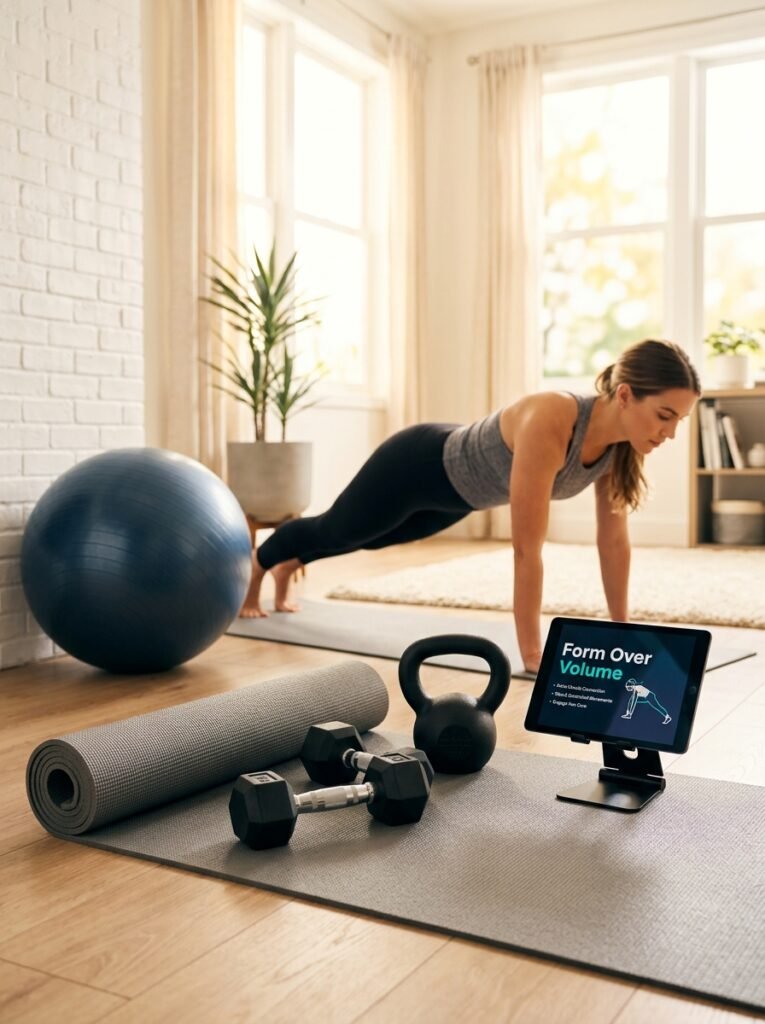
Doing the right exercise is only part of the equation.
How you perform it matters too.
Focus on Form
A sloppy 30-second plank isn’t necessarily better than a controlled 15-second plank.
Keep your movements slow enough that you can feel which muscles are working.
Breathe
Don’t hold your breath during core exercises.
Try breathing steadily throughout the movement. Exhale during the more demanding part of an exercise when it feels natural.
Keep Your Core Braced, Not Sucked In
You don’t need to pull your stomach in as hard as possible.
Instead, gently tighten your abdominal muscles as if you’re preparing for a light bump to the stomach.
You should still be able to breathe.
Progress Gradually
Once an exercise becomes comfortable, make a small change.
You could:
- Add a few repetitions
- Increase the hold by 5–10 seconds
- Slow down the movement
- Add another set
- Try a slightly harder variation
Small progress adds up.
Core Exercises vs. Belly Fat: What You Need to Know
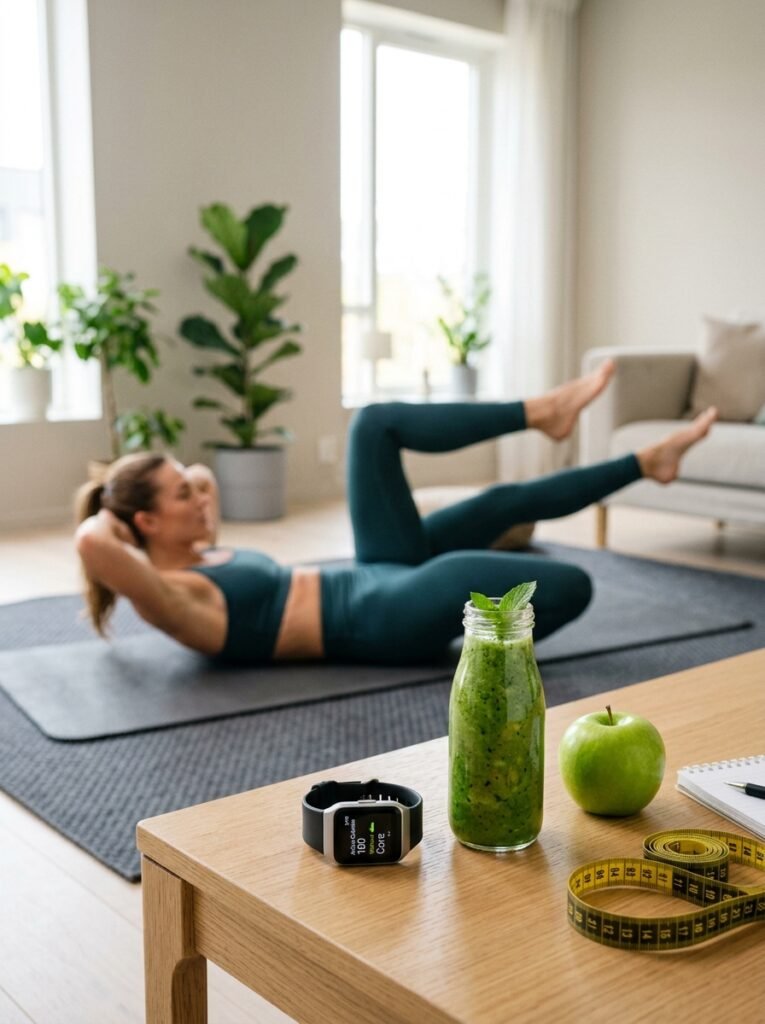
If your main goal is losing belly fat, it’s important to separate two different goals.
Core training builds and strengthens muscle.
Fat loss reduces overall body fat.
These processes can happen at the same time, but one doesn’t automatically cause the other.
If you’re trying to lose weight, a moderate calorie deficit can help. That means consistently consuming somewhat less energy than your body uses, rather than dramatically restricting food.
You don’t need to starve yourself.
A balanced diet built around vegetables, fruits, whole grains, protein-rich foods, healthy fats, and minimally processed foods can be much easier to maintain.
Add Walking to Your Routine

Walking is underrated.
You don’t have to spend every day doing intense cardio to become more active.
A brisk walk after a meal, a short walk during your lunch break, or an evening walk around your neighborhood can all help you increase daily movement.
Try adding movement in ways that fit naturally into your schedule.
For example:
- Take the stairs when practical.
- Walk while talking on the phone.
- Take a short walk after dinner.
- Park slightly farther away when appropriate.
- Take regular movement breaks if you sit for long periods.
The best activity is often the one you can keep doing.
Don’t Ignore Full-Body Strength Training
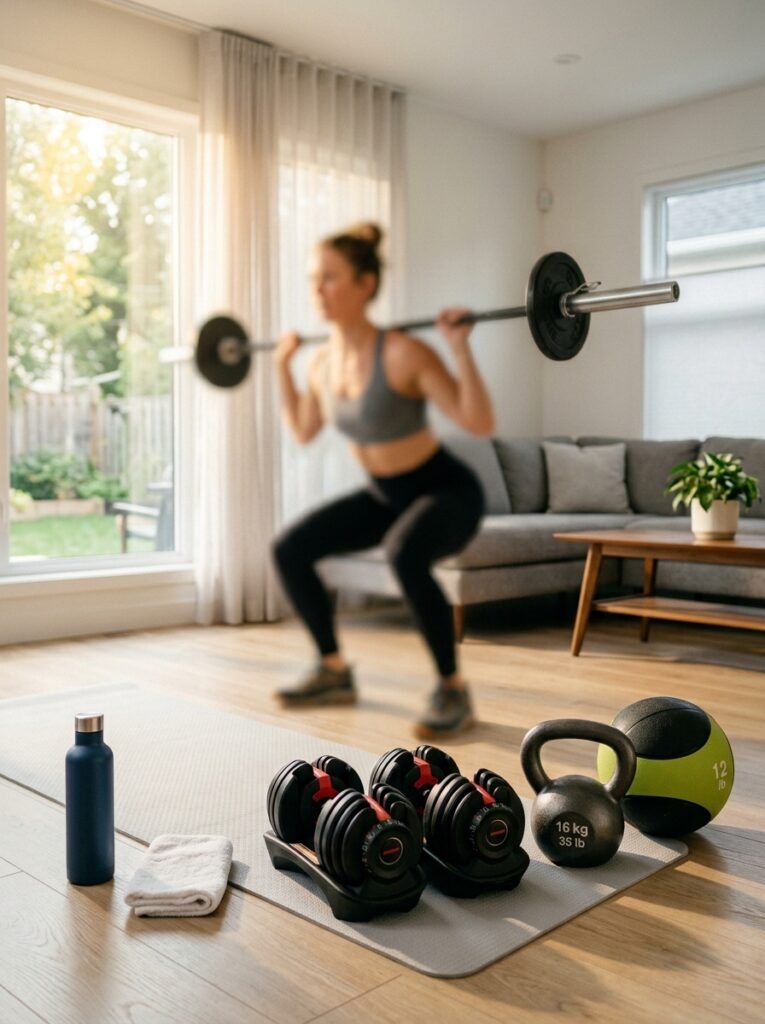
If you want a stronger, leaner-looking body, don’t make your workout routine 100% abs.
Squats, lunges, push-ups, rows, hip hinges, and other resistance exercises train large muscle groups and help you develop overall strength.
You can perform many of these movements at home using body weight.
A balanced workout could include:
- Squats
- Glute bridges
- Push-ups or modified push-ups
- Lunges
- Bird dogs
- Planks
This gives you a much more complete workout than doing crunches alone.
What Should You Eat for a Flatter Stomach?

There’s no special food that magically melts belly fat.
However, your everyday food choices can make a major difference in your overall nutrition and weight-management efforts.
Build meals around foods that keep you satisfied.
Include Protein
Protein can help support muscle and make meals more filling.
Good options include:
- Eggs
- Greek yogurt
- Chicken
- Fish
- Beans
- Lentils
- Cottage cheese
- Tofu
- Lean meat
Eat More Fiber-Rich Foods
Fiber is found in foods such as:
- Vegetables
- Fruits
- Beans
- Lentils
- Oats
- Whole grains
- Nuts and seeds
Increase fiber gradually if your current intake is low, and drink enough fluids.
Don’t Fear Carbohydrates
You don’t need to eliminate carbohydrates to lose belly fat.
Potatoes, oats, rice, fruit, beans, and whole grains can all fit into a balanced diet.
What matters is your overall eating pattern and portion sizes.
What About Bloating?
Sometimes your stomach looks larger because of bloating rather than changes in body fat.
Bloating can happen for many reasons, including eating certain foods, consuming large meals, changes in bowel habits, swallowing air, or individual food sensitivities.
If you frequently experience uncomfortable or persistent bloating, don’t automatically assume you need to cut out entire food groups.
Instead, pay attention to patterns and consider speaking with a qualified healthcare professional if symptoms are persistent or concerning.
Common Mistakes When Doing Core Exercises
Even simple exercises can become ineffective when performed incorrectly.
Doing Hundreds of Crunches
More repetitions don’t automatically mean better results.
If your goal is a stronger core, quality and progressive training are more useful than chasing huge repetition numbers.
Training Abs Every Day
Your abdominal muscles need recovery.
Give your body time to adapt, especially when you’re new to exercise.
Using Momentum
Swinging your legs or jerking your torso can make exercises easier while reducing control.
Slow down.
Ignoring the Rest of Your Body
A strong core is important, but your legs, back, chest, shoulders, and glutes deserve attention too.
Think of core training as part of your overall fitness plan.
Expecting Overnight Results
This is probably the biggest mistake.
Your body doesn’t change dramatically in a few days.
Focus on what you can repeat for months rather than what promises results in a week.
How to Stay Consistent With Core Workouts
You don’t need perfect motivation.
You need a routine that’s easy enough to repeat.
Try these simple strategies:
- Keep your workout under 15–20 minutes at first.
- Exercise at the same time on specific days.
- Keep a yoga mat somewhere visible.
- Track your workouts rather than obsessing over the scale.
- Increase difficulty gradually.
- Choose exercises you don’t hate.
- Don’t quit because you missed one workout.
If you miss Monday, you haven’t failed.
Just start again Tuesday.
When Should You Expect Results?
Everyone responds differently to exercise and nutrition.
Your results depend on your starting point, genetics, diet, activity levels, sleep, training consistency, and many other factors.
You may notice improved stability and strength before you see obvious visual changes.
That’s still progress.
Pay attention to other signs too:
- Planks feel easier.
- You can perform more controlled repetitions.
- Your posture feels better.
- Everyday movements feel easier.
- Your energy improves.
- Your clothes fit differently.
A stronger body is a worthwhile result even before visible changes happen.
A Simple Weekly Plan for a Stronger, Flatter-Looking Midsection
If you’re not sure where to start, keep it simple.
Monday: Core
- Dead bugs — 10 per side
- Forearm plank — 20–30 seconds
- Glute bridges — 15 reps
- Bird dogs — 10 per side
- Heel taps — 12 per side
Repeat for 2 rounds.
Tuesday: Walking
Take a brisk walk for 20–30 minutes or choose another activity you enjoy.
Wednesday: Full-Body Strength
Try:
- Squats
- Wall or incline push-ups
- Glute bridges
- Lunges
- Bird dogs
Keep the workout manageable.
Thursday: Core
Repeat the Monday routine or choose slightly different exercises.
Friday: Easy Movement
Go for a walk, stretch, or do another low-intensity activity.
Saturday: Optional Workout
If you’re feeling good, complete a short full-body or core session.
Sunday: Recovery
Take a rest day or do gentle movement.
You don’t have to follow this exact schedule.
Use it as a starting point and adjust it around your life.
Safety Tips for Home Core Workouts
Core exercises are generally accessible, but they aren’t appropriate for everyone in every situation.
Stop an exercise if you experience sharp pain, dizziness, unusual shortness of breath, or other concerning symptoms.
If you have an injury, are pregnant or recently gave birth, or have a medical condition that affects exercise, talk with an appropriate healthcare professional about which movements are suitable for you.
Pain isn’t a sign that an exercise is working.
Good training should challenge you without making you feel injured.
Frequently Asked Questions
Your Simple Starting Point
You don’t need to transform your entire lifestyle tomorrow.
Start with 10–15 minutes of core exercises at home for a flat stomach, two or three times this week. Add regular walking and balanced meals, then gradually build from there.
The goal isn’t to punish your body until your stomach changes.
It’s to build a stronger body and healthier routine that you can actually live with.