
At-Home Belly Fat Workout for Women/Men
If you’re trying to lose belly fat, you don’t need a fancy gym membership, expensive equipment, or hours of exhausting cardio.
The right at-home belly fat workout for women/men can help you build muscle, increase daily activity, improve fitness, and support overall fat loss—all from your living room.
But there’s one important thing to understand first: you can’t choose exactly where your body loses fat. Your body decides where it stores and releases fat based on factors such as genetics, hormones, age, activity levels, sleep, and overall energy balance.
So instead of chasing hundreds of crunches, we’re going to focus on something much more useful: a simple home workout that strengthens your core while helping you become more active and consistent.
Key Takeaways
- You cannot specifically burn belly fat with abdominal exercises alone, but you can strengthen and tone your core while losing overall body fat.
- A combination of strength exercises, cardio, daily movement, and sensible nutrition works better than endless crunches.
- You can complete this beginner-friendly workout at home with little or no equipment.
- Consistency matters more than doing an extreme workout once or twice a week.
Can an At-Home Workout Really Help You Lose Belly Fat?
Yes—but probably not in the way you might expect.
Ab exercises strengthen the muscles underneath your belly, but they don’t tell your body to burn fat specifically from your stomach.
When you lose body fat, your body draws energy from fat stores throughout the body. Where you notice changes first depends largely on your individual body composition and genetics.
That’s why the best at-home belly fat workout for women/men should not be just a collection of stomach exercises.
Instead, your routine should combine:
- Full-body strength exercises
- Core exercises
- Moderate cardio
- Regular daily movement
- Enough recovery
- A sustainable eating pattern
This approach gives you a much better foundation for long-term results.
The Best At-Home Belly Fat Workout for Women/Men
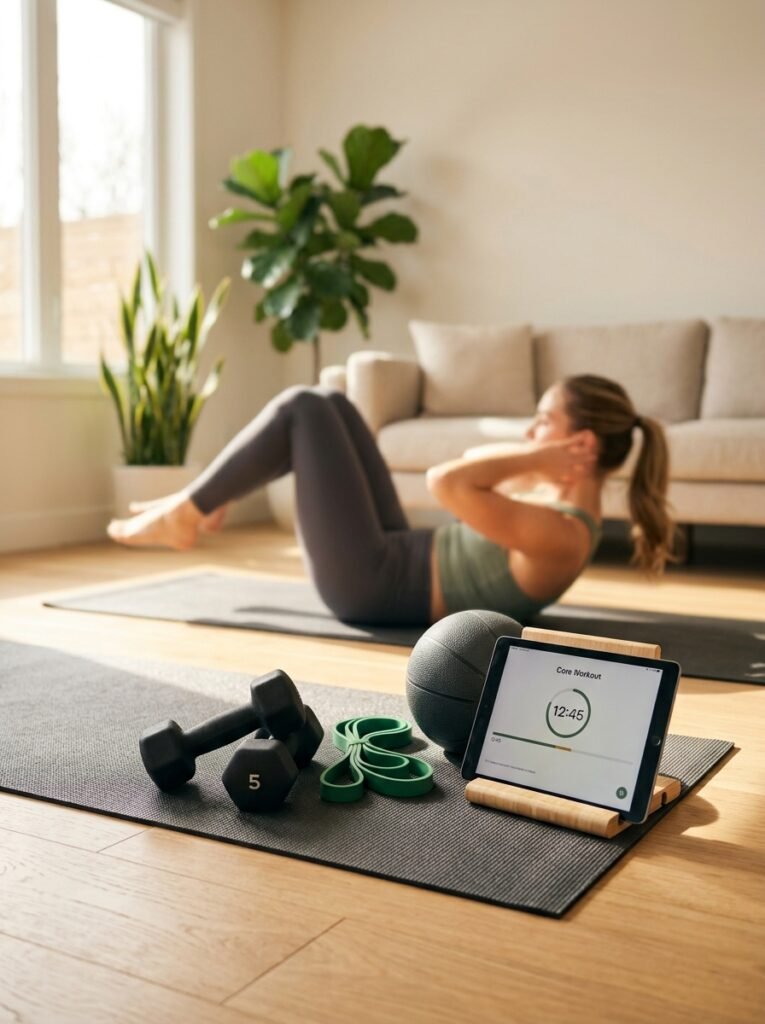
You don’t need to spend an hour exercising.
If you’re a beginner, start with this 20-minute at-home belly fat workout for women/men about 3–4 times per week.
You’ll need:
- A comfortable exercise mat or carpet
- A sturdy chair or wall if needed
- A water bottle
- Comfortable clothing
- About 20 minutes
Your 20-Minute Routine
Perform each exercise for 40 seconds, followed by 20 seconds of rest.
Complete the circuit 2–3 times depending on your fitness level.
- March in place
- Bodyweight squats
- Incline push-ups
- Glute bridges
- Mountain climbers
- Reverse lunges
- Dead bugs
- Plank
- Standing knee drives
- Slow high-knee march
Take a 60–90 second break between rounds.
If you’re new to exercise, start with two rounds. You don’t need to push yourself to exhaustion for the workout to be effective.
1. March in Place
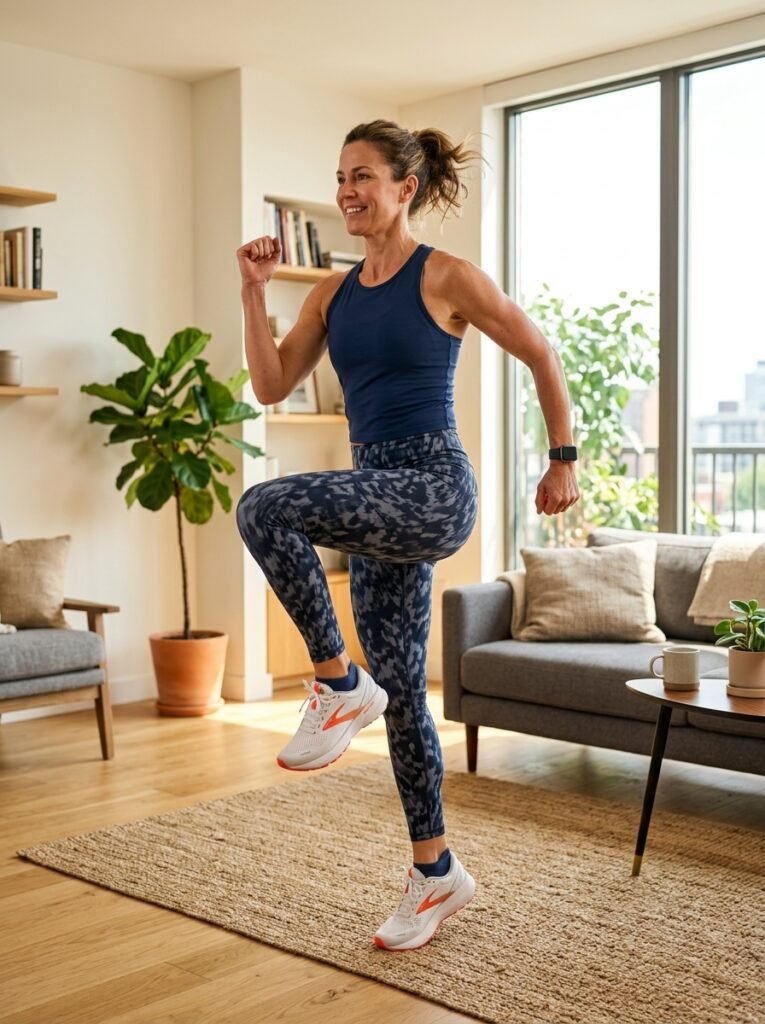
Start your workout with an easy march to gradually increase your heart rate.
Stand tall, lift one knee at a time, and swing your arms naturally.
How to do it
- Stand with your feet about hip-width apart.
- Lift your right knee comfortably.
- Lower it and lift your left knee.
- Continue alternating.
- Move your arms naturally.
- Keep your shoulders relaxed.
For a greater challenge, gradually increase the pace.
If high-impact movements bother your joints, marching is a great low-impact alternative.
2. Bodyweight Squats
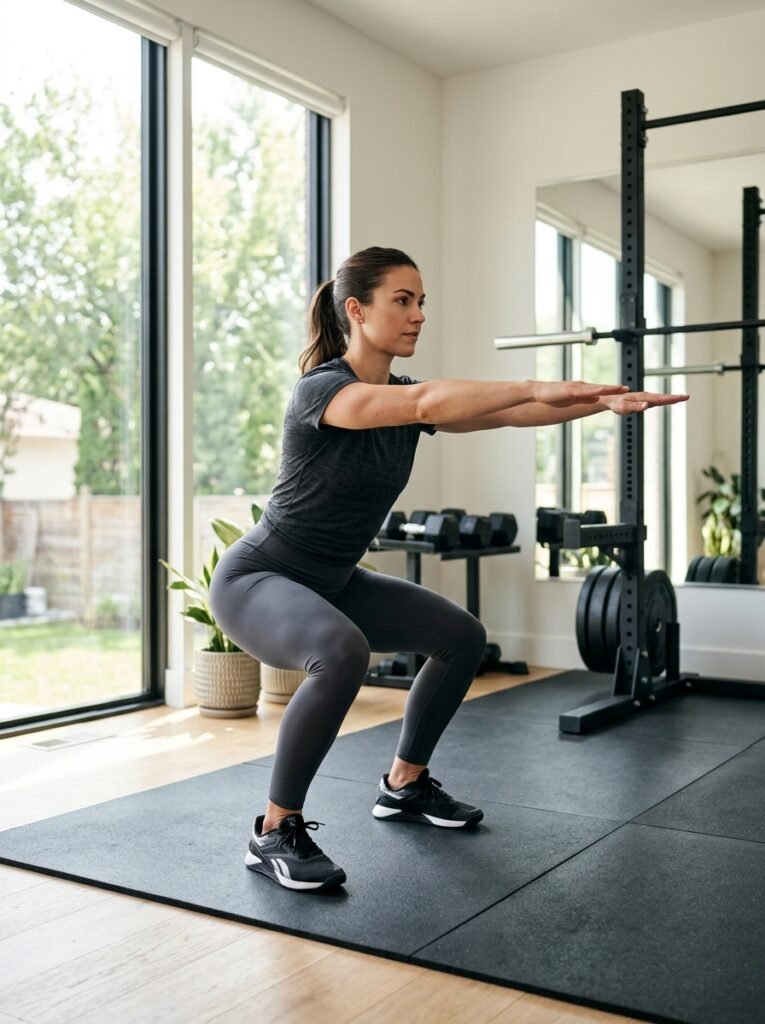
Squats work your thighs, glutes, hips, and core.
Because they involve several large muscle groups, they’re a useful addition to a full-body home workout.
How to do them
- Stand with your feet roughly shoulder-width apart.
- Push your hips backward as though you’re sitting into a chair.
- Bend your knees and lower as far as comfortable.
- Keep your chest lifted.
- Push through your feet to return to standing.
Aim for controlled movement rather than speed.
If regular squats feel difficult, place a chair behind you and practice sitting down and standing back up with control.
3. Incline Push-Ups
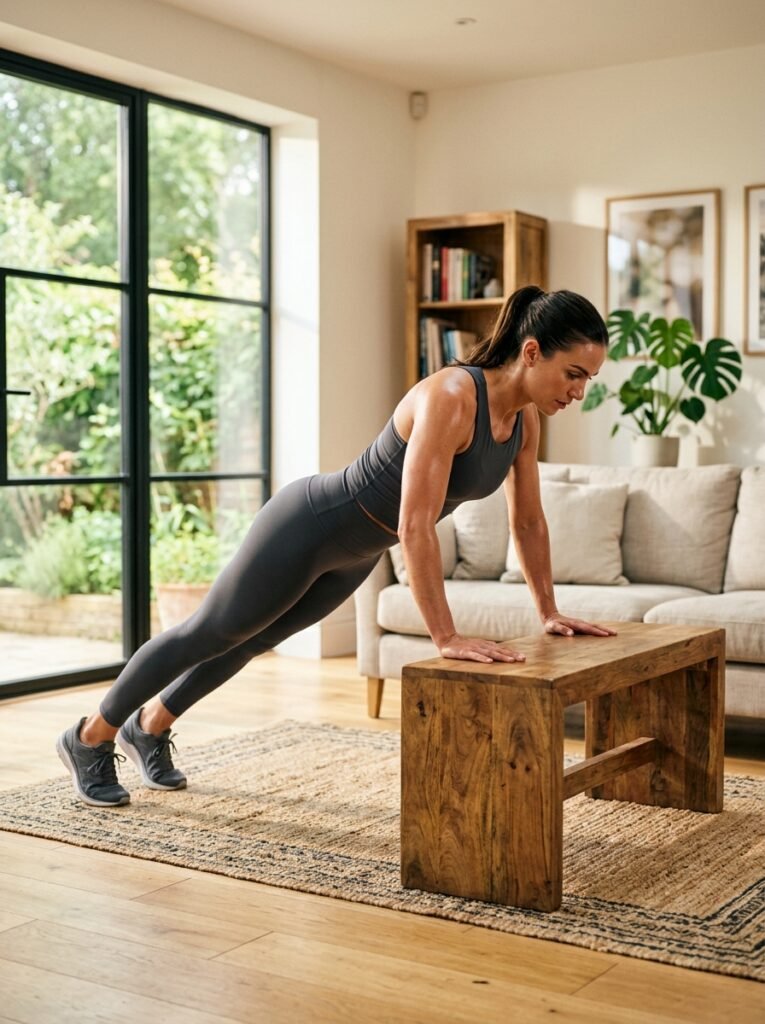
You don’t have to start with traditional floor push-ups.
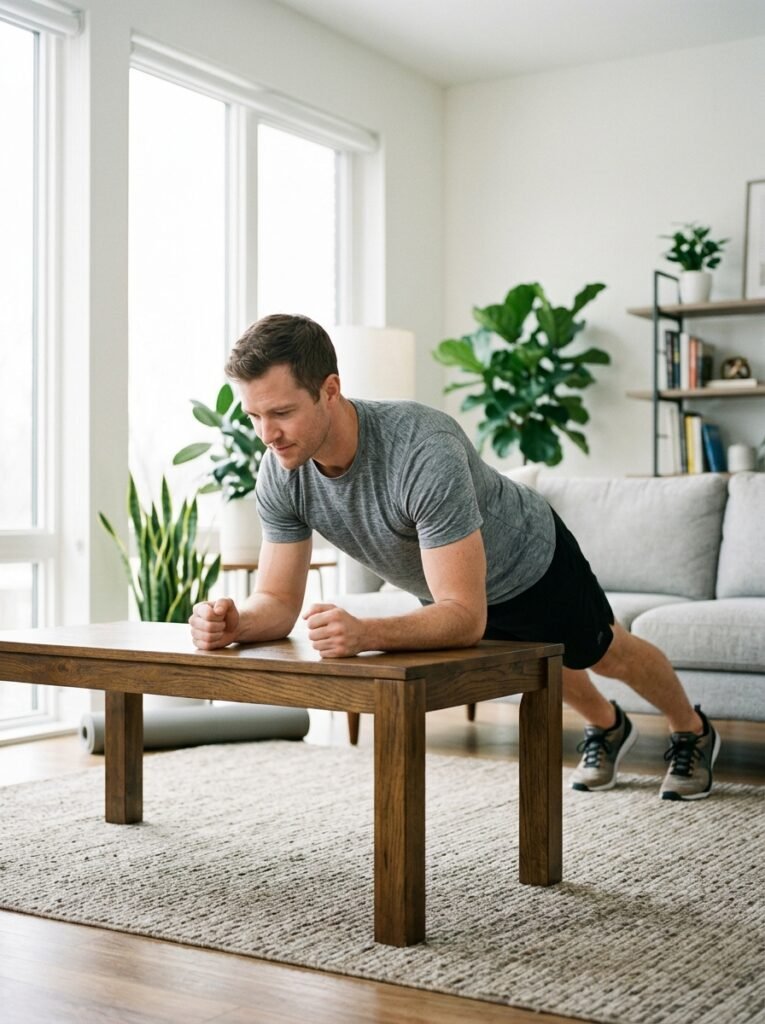
Incline push-ups using a sturdy countertop, table, or wall can help you build upper-body strength while keeping the movement more accessible.
How to do them
- Place your hands on a stable elevated surface.
- Walk your feet backward.
- Keep your body in a straight line.
- Bend your elbows and bring your chest toward the surface.
- Push yourself back to the starting position.
Keep your core gently engaged throughout the movement.
As you become stronger, gradually use a lower surface.
4. Glute Bridges
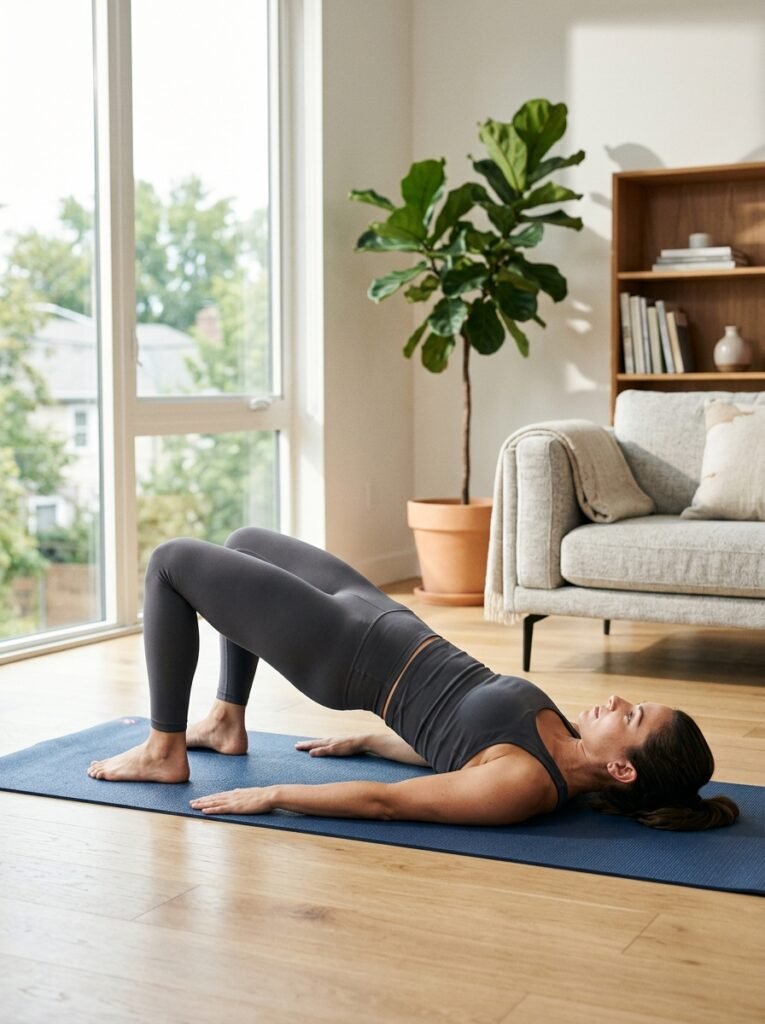
Your glutes and hips play an important role in lower-body strength, and glute bridges are simple to perform at home.
They also require your core to help stabilize your body.
How to do them
- Lie on your back.
- Bend your knees and place your feet flat on the floor.
- Keep your arms beside your body.
- Tighten your abdominal muscles gently.
- Press through your feet.
- Lift your hips toward the ceiling.
- Pause briefly at the top.
- Lower slowly.
Don’t arch your lower back excessively.
Think about squeezing your glutes rather than trying to lift your hips as high as possible.
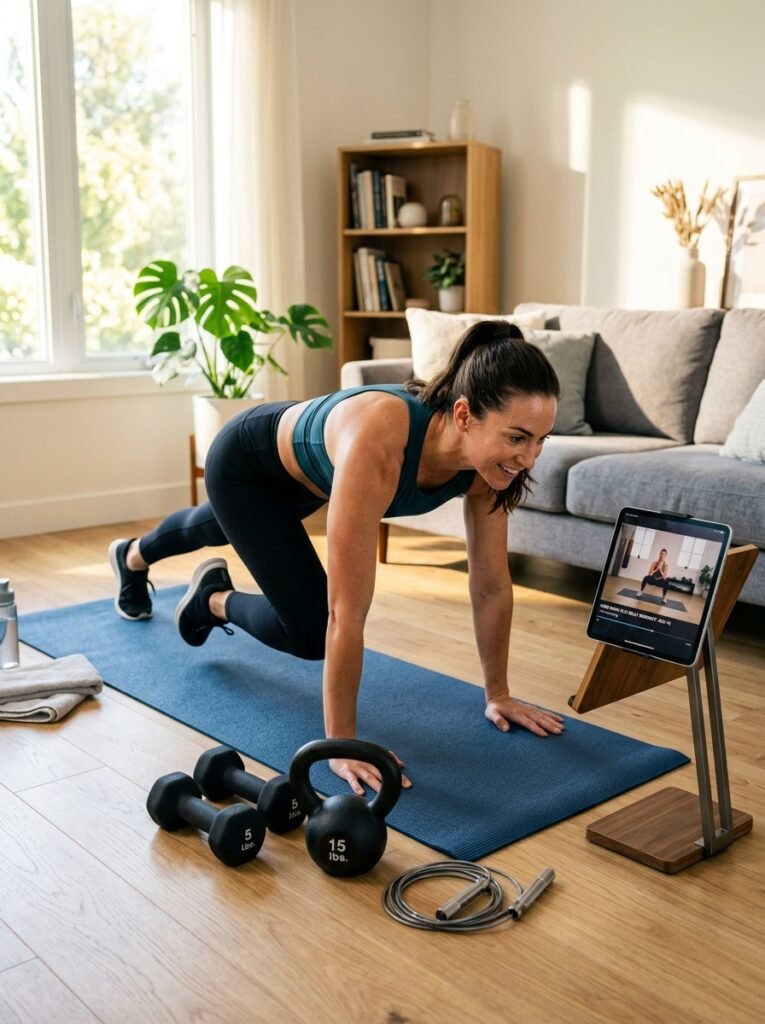
5. Mountain Climbers
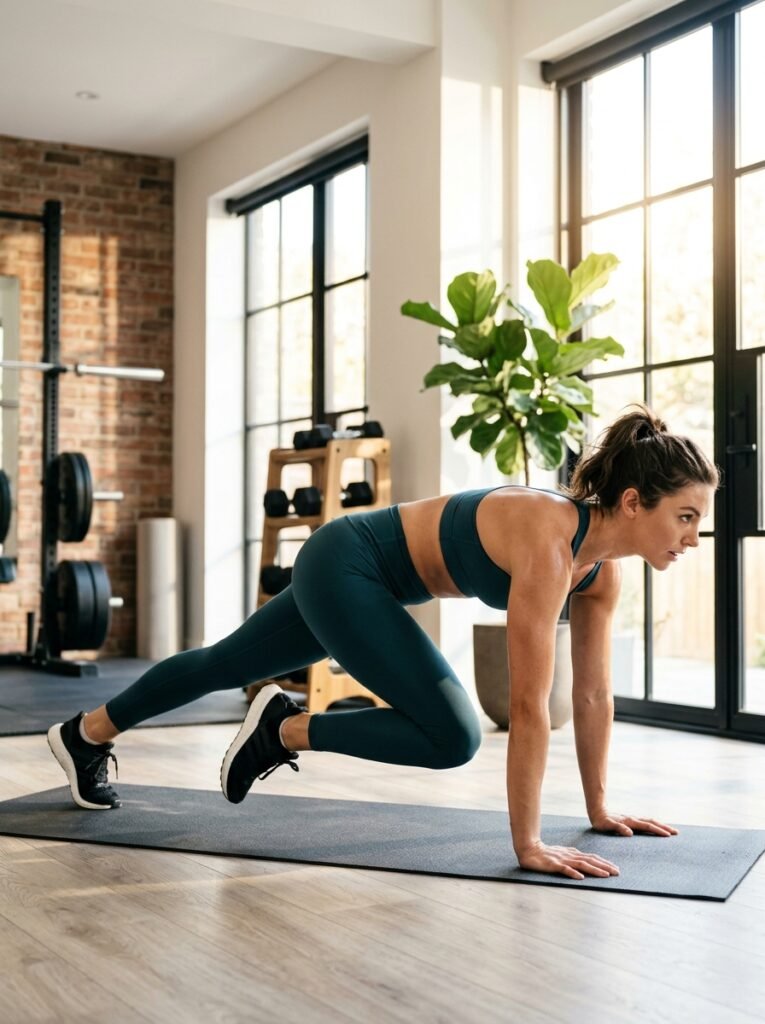
Mountain climbers can raise your heart rate while challenging your shoulders, legs, and core.
However, you don’t have to perform them quickly.
Beginner version
- Start in a high plank position.
- Bring one knee toward your chest.
- Return it to the starting position.
- Bring the other knee forward.
- Continue alternating slowly.
Keep your hips relatively stable.
If the floor position doesn’t feel comfortable, perform the movement with your hands against a sturdy elevated surface.
6. Reverse Lunges
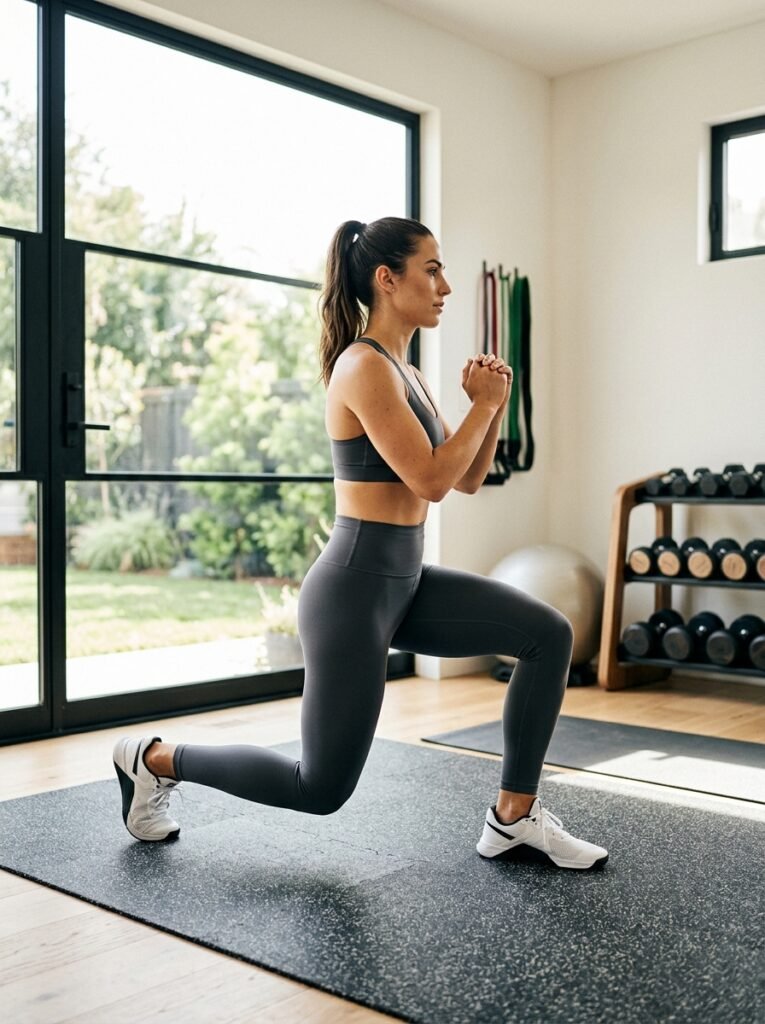
Reverse lunges work your legs and glutes while challenging your balance and stability.
Many beginners find stepping backward more comfortable than stepping forward.
How to do them
- Stand tall with your feet together.
- Step your right foot backward.
- Bend both knees comfortably.
- Push through your front foot.
- Return to standing.
- Repeat on the opposite side.
Hold onto a wall or chair if you need additional balance.
Don’t worry about making your lunge extremely deep. Good control is more important.
7. Dead Bugs
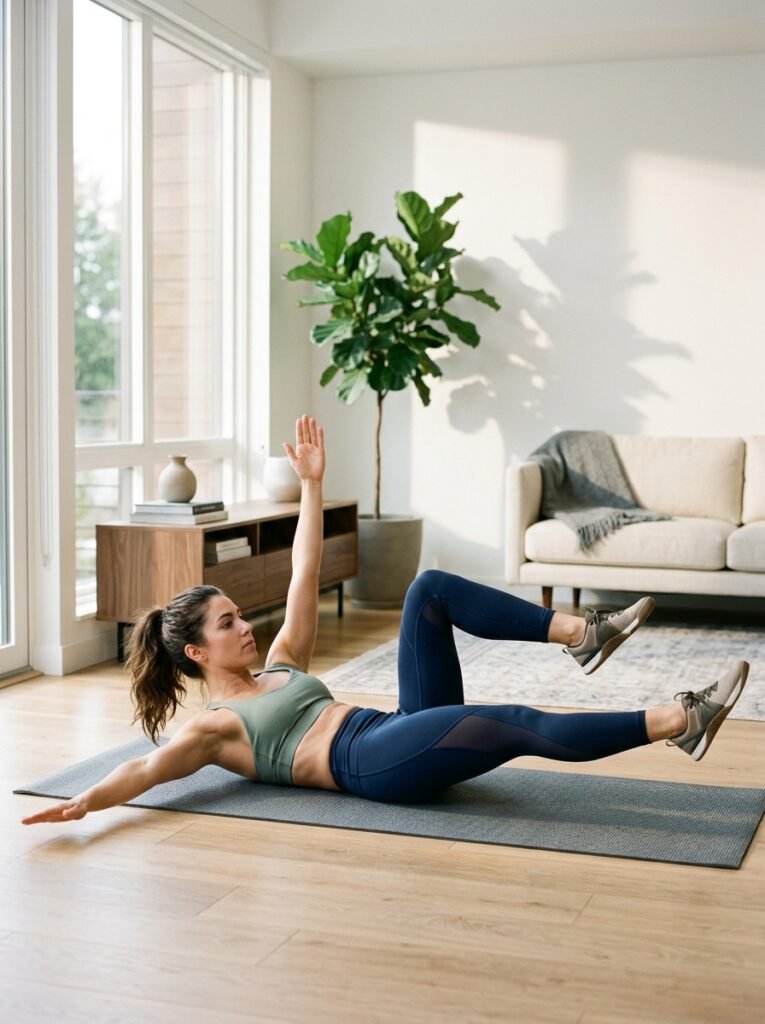
If you’re looking for an effective core exercise, don’t overlook the dead bug.
It teaches you to brace your core while moving your arms and legs, making it a useful addition to a beginner-friendly workout.
How to do them
- Lie on your back.
- Lift your knees over your hips.
- Bend your knees to about 90 degrees.
- Extend your arms toward the ceiling.
- Slowly lower one arm and the opposite leg.
- Bring them back.
- Switch sides.
Keep your lower back comfortably controlled against the floor.
If your back starts arching, reduce the range of motion.
8. Plank
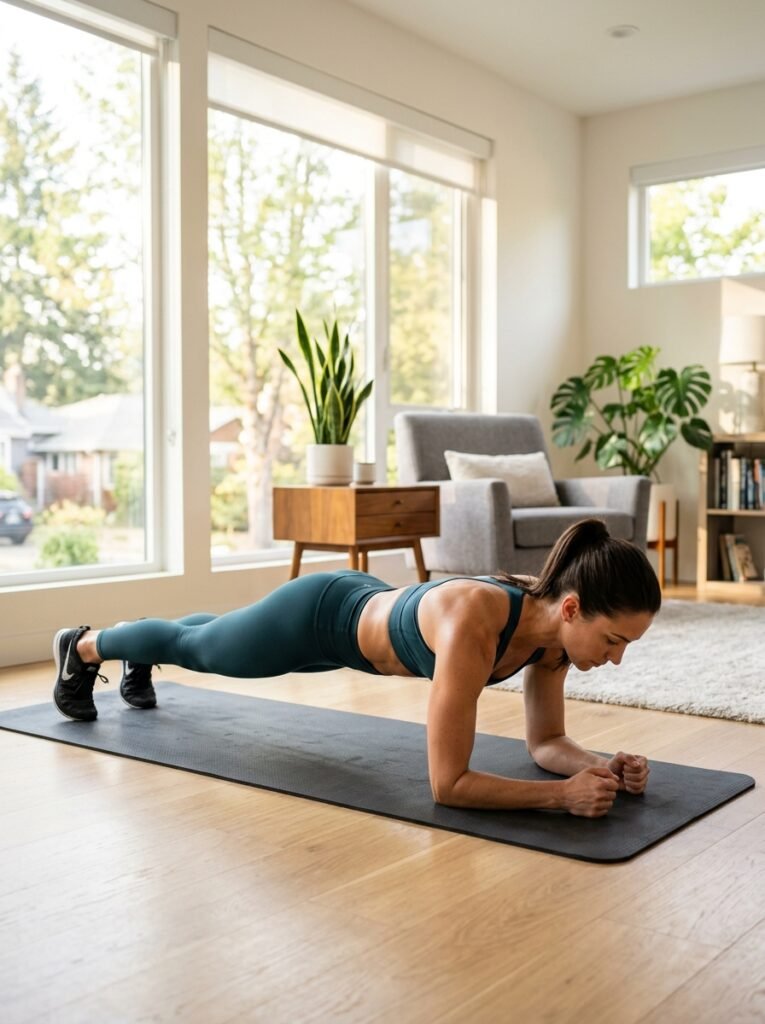
Planks train your core to resist movement rather than repeatedly bending your spine.
You don’t need to hold a plank for several minutes.
Start with 15–30 seconds
- Place your forearms on the floor.
- Extend your legs behind you.
- Keep your body in a relatively straight line.
- Brace your abdomen gently.
- Breathe normally.
- Stop before your form breaks down.
If a full plank is too difficult, keep your knees on the floor.
A shorter plank with good technique is more useful than a long, uncomfortable hold.
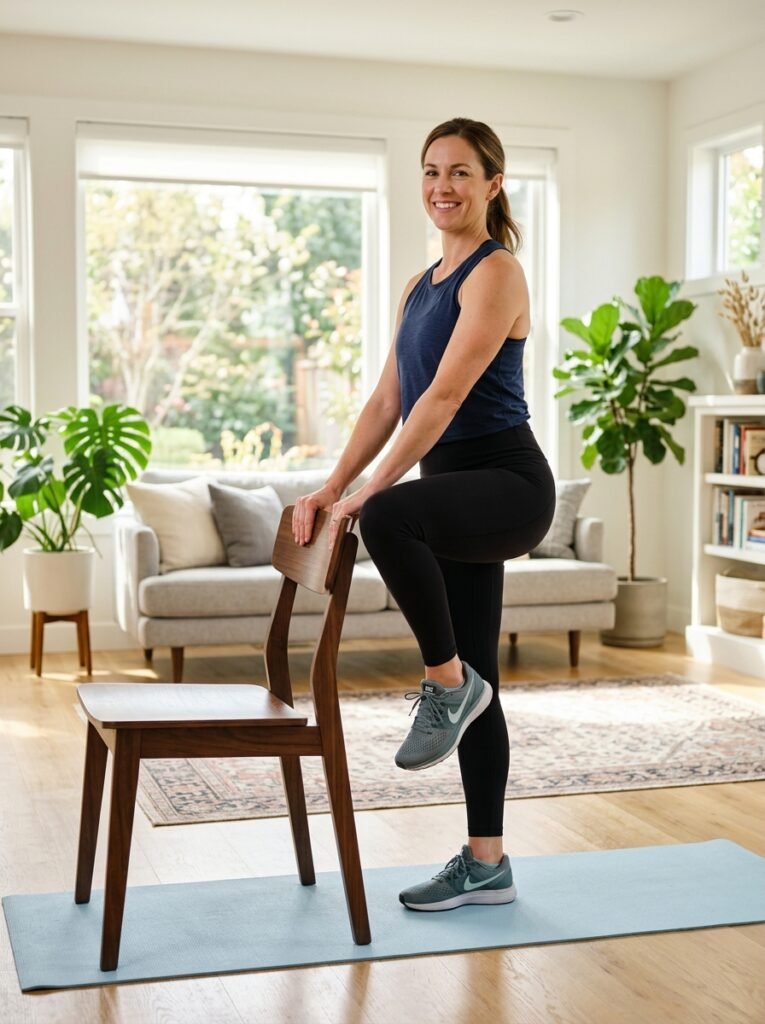
9. Standing Knee Drives
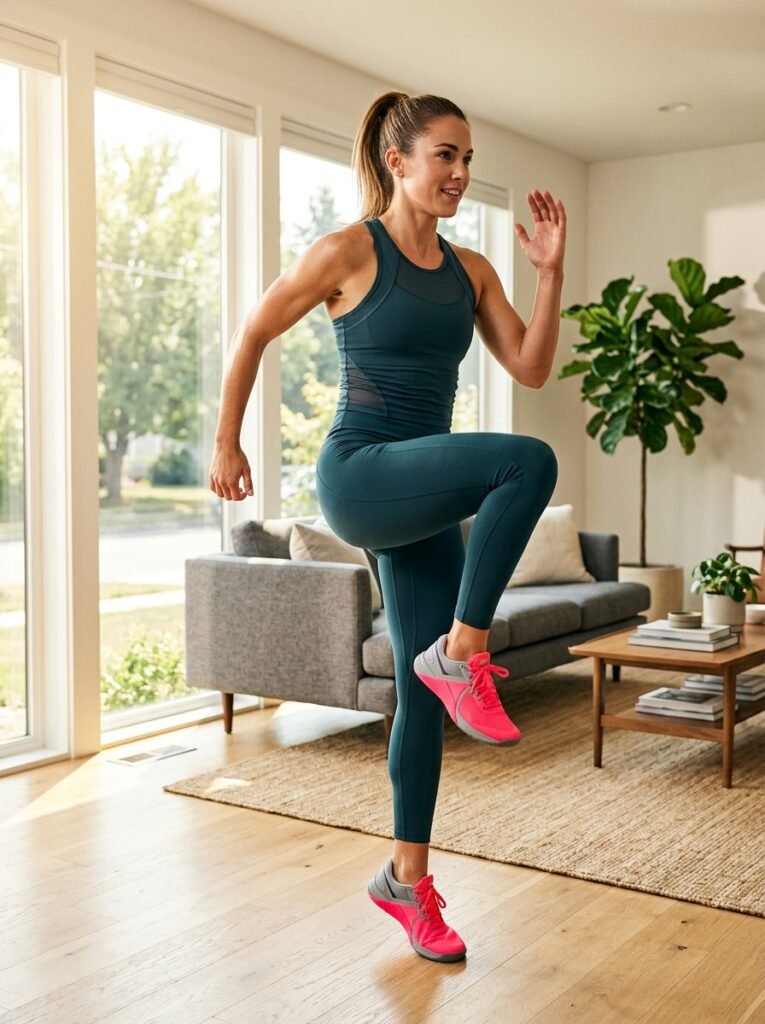
Standing knee drives are a convenient way to add movement without getting on the floor.
They’re particularly useful if you’re exercising in a small space.
How to do them
- Stand tall.
- Lift your right knee toward your torso.
- Lower it slowly.
- Lift your left knee.
- Continue alternating.
- Gradually increase your pace if comfortable.
You can also gently rotate your torso toward the lifted knee, but don’t force the rotation.
10. Slow High-Knee March
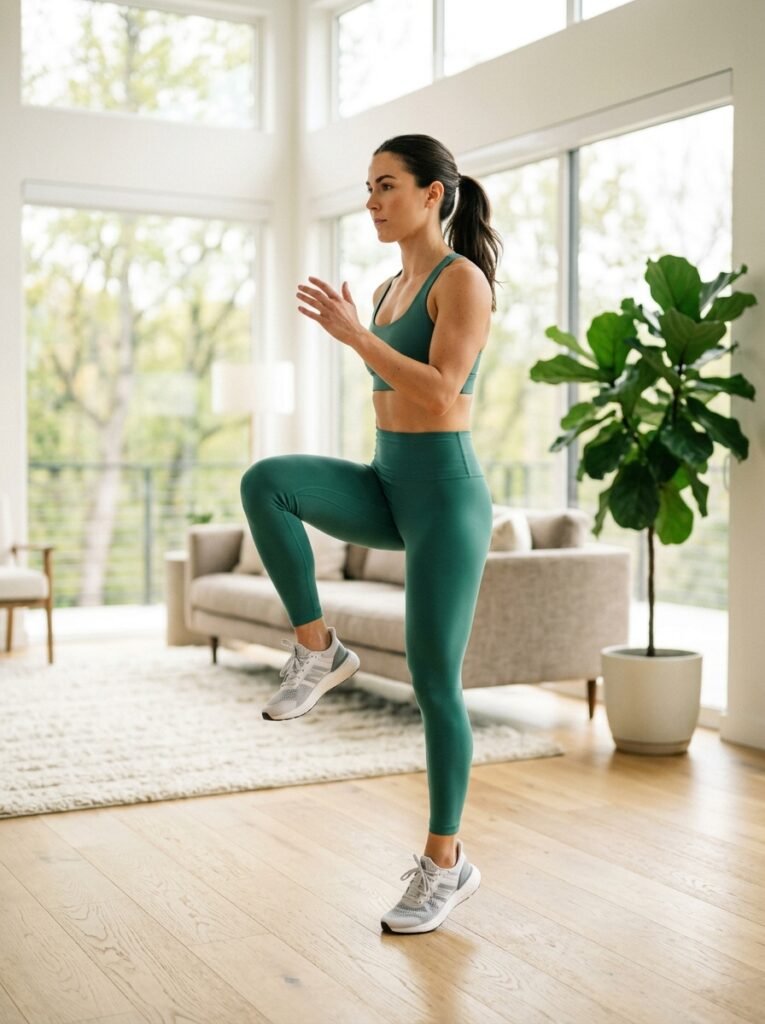
Finish the circuit with a controlled high-knee march.
This gives you a simple cardio-focused movement without requiring jumping.
Lift your knees as high as feels comfortable while keeping your posture upright.
If you’re feeling energetic, increase the pace.
If you’re tired, slow it down.
The goal isn’t to completely drain yourself. The goal is to finish the workout feeling like you could still function normally afterward.
How Often Should You Do This Workout?
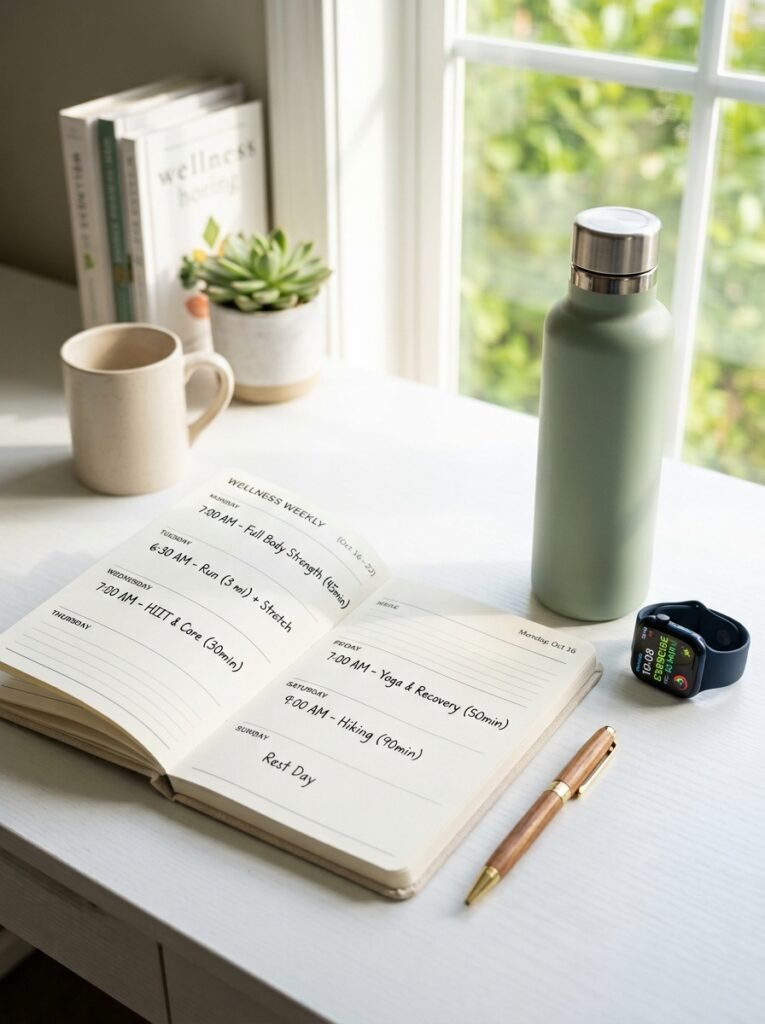
For most beginners, 3–4 workout sessions per week is a reasonable starting point.
You don’t need to train your abs every day.
Your muscles also need time to recover, particularly when you’re introducing new exercises.
A simple weekly schedule could look like this:
- Monday: Full-body home workout
- Tuesday: Walking or light activity
- Wednesday: Full-body home workout
- Thursday: Rest or easy movement
- Friday: Full-body home workout
- Saturday: Walking or another enjoyable activity
- Sunday: Rest
If you’re completely new to exercise, start with three sessions per week.
Once the routine feels manageable, you can gradually increase your activity.
At-Home Belly Fat Workout for Women: Helpful Modifications
Women don’t need a completely different fat-loss workout from men.
The basic principles of fat loss and muscle development are similar, although individual fitness levels, preferences, medical considerations, and training history can vary.
If you’re a woman getting started at home, focus on building strength gradually rather than trying to burn as many calories as possible.
Make the workout easier when needed
Try:
- Wall push-ups instead of floor push-ups
- Chair squats instead of deep squats
- Step-back lunges with support
- Marching instead of jumping
- Knee-supported planks
- Shorter workout intervals
You can make a workout challenging without making it punishing.
At-Home Belly Fat Workout for Men: Helpful Modifications
Men can use the same basic workout and adjust the difficulty according to their fitness level.
If you’ve already been exercising regularly, you may need more resistance or a greater challenge to keep progressing.
You can gradually add:
- A resistance band
- Dumbbells
- A weighted backpack
- Longer work intervals
- More repetitions
- Additional circuit rounds
Don’t add everything at once.
Choose one progression and give your body time to adapt.
Why Crunches Alone Won’t Get Rid of Belly Fat
Crunches aren’t bad.
They’re simply not a magic belly-fat exercise.
They strengthen your abdominal muscles, but doing hundreds of crunches doesn’t guarantee that the fat covering those muscles will disappear.
That’s why I wouldn’t build an entire fat-loss plan around abdominal exercises.
Instead, use core exercises as one piece of a larger routine.
Your program should include movements that train your:
- Legs
- Glutes
- Back
- Chest
- Shoulders
- Arms
- Core
A stronger body is more useful than simply having stronger abs.
How Walking Can Help With Belly Fat Loss

Walking is one of the easiest forms of physical activity to add to your routine.
You don’t need to walk at an extreme pace or complete a huge number of steps every day.
Start with what you can realistically maintain.
For example, you could:
- Take a 10-minute walk after lunch.
- Walk while talking on the phone.
- Take the stairs when practical.
- Walk around your home during short breaks.
- Add a short evening walk.
Small amounts of movement can add up.
If you currently do very little activity, even a modest increase can be a meaningful step forward.
Nutrition Still Matters
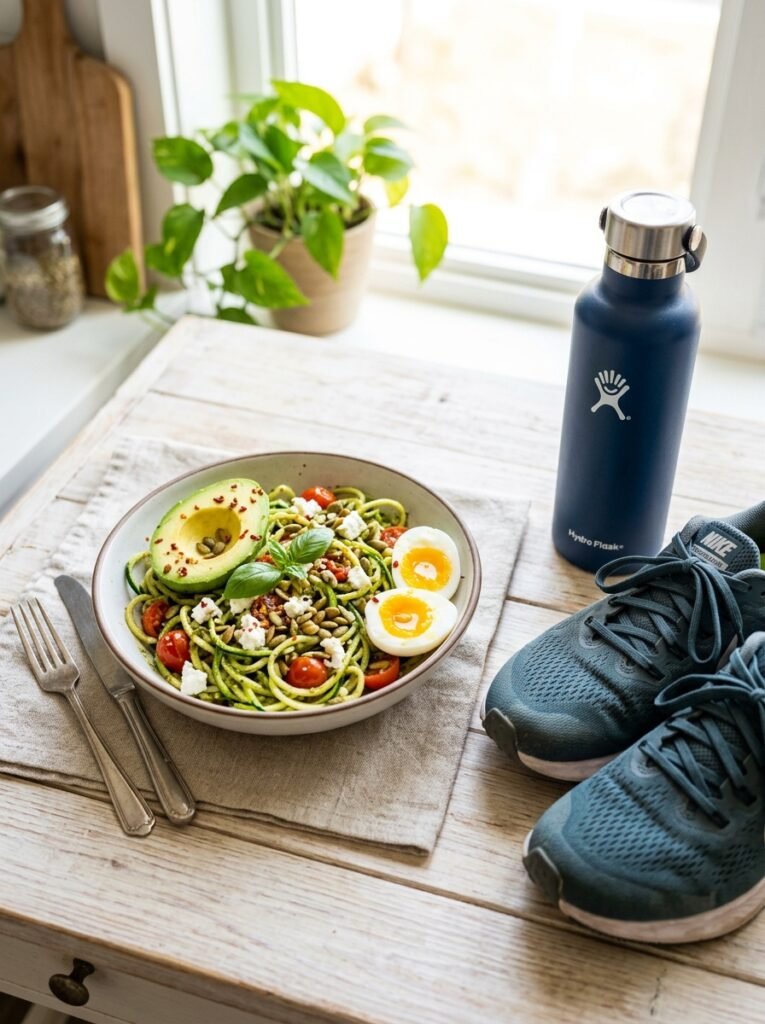
Exercise is valuable, but your eating habits also matter if your goal is to reduce body fat.
You don’t need a crash diet.
You don’t need to eliminate carbohydrates.
And you don’t need to survive on salads.
Instead, build meals around foods that help you feel satisfied.
A simple meal formula
Try including:
Protein + vegetables or fruit + high-fiber carbohydrates + healthy fats
For example:
- Eggs with whole-grain toast and fruit
- Chicken with rice and vegetables
- Greek yogurt with berries and nuts
- Lentils with vegetables and whole-grain roti
- Fish with potatoes and salad
- Beans with brown rice and vegetables
The exact foods can vary based on your culture, budget, preferences, and dietary needs.
Protein Can Make Your Meals More Satisfying
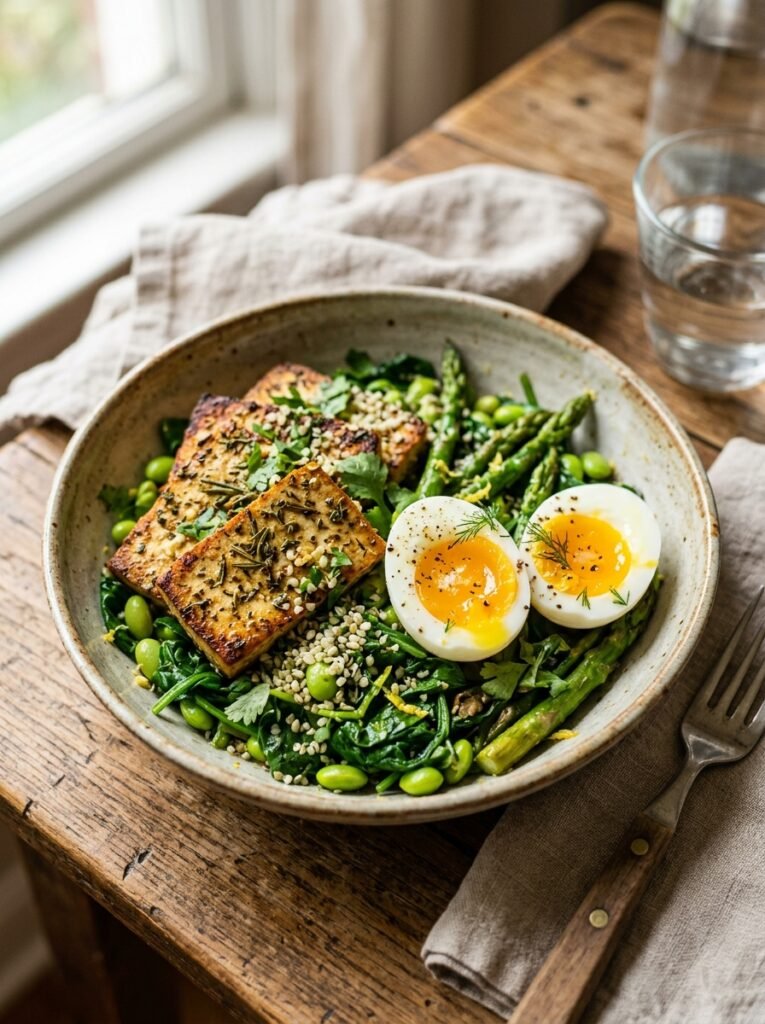
Protein helps support muscle maintenance and growth, particularly when you’re exercising regularly.
Good options include:
- Eggs
- Chicken
- Fish
- Greek yogurt
- Milk
- Cottage cheese
- Lentils
- Beans
- Chickpeas
- Tofu
- Other protein-rich foods you enjoy
You don’t need to obsess over protein numbers.
Simply try to include a meaningful protein source in most meals.
Don’t Fear Carbohydrates

If you’ve ever tried losing belly fat, you’ve probably heard that carbohydrates are the problem.
They’re not.
Foods such as oats, potatoes, rice, fruit, beans, and whole grains can all fit into a balanced diet.
The bigger picture is your overall eating pattern and energy intake.
Choosing mostly minimally processed foods and paying attention to portions can be much more sustainable than completely removing an entire food group.
What About Sugar?

You don’t have to completely eliminate sugar to lose body fat.
However, sugary drinks, sweets, and highly processed snacks can be easy to overconsume because they often provide lots of calories without keeping you full for very long.
Try making simple swaps.
For example:
- Water instead of sugary drinks
- Fruit instead of candy when you want something sweet
- Plain or lightly sweetened yogurt instead of heavily sweetened desserts
- Homemade snacks instead of frequent packaged treats
You can still enjoy your favorite foods.
The goal is balance, not perfection.
How Long Does It Take to Lose Belly Fat?
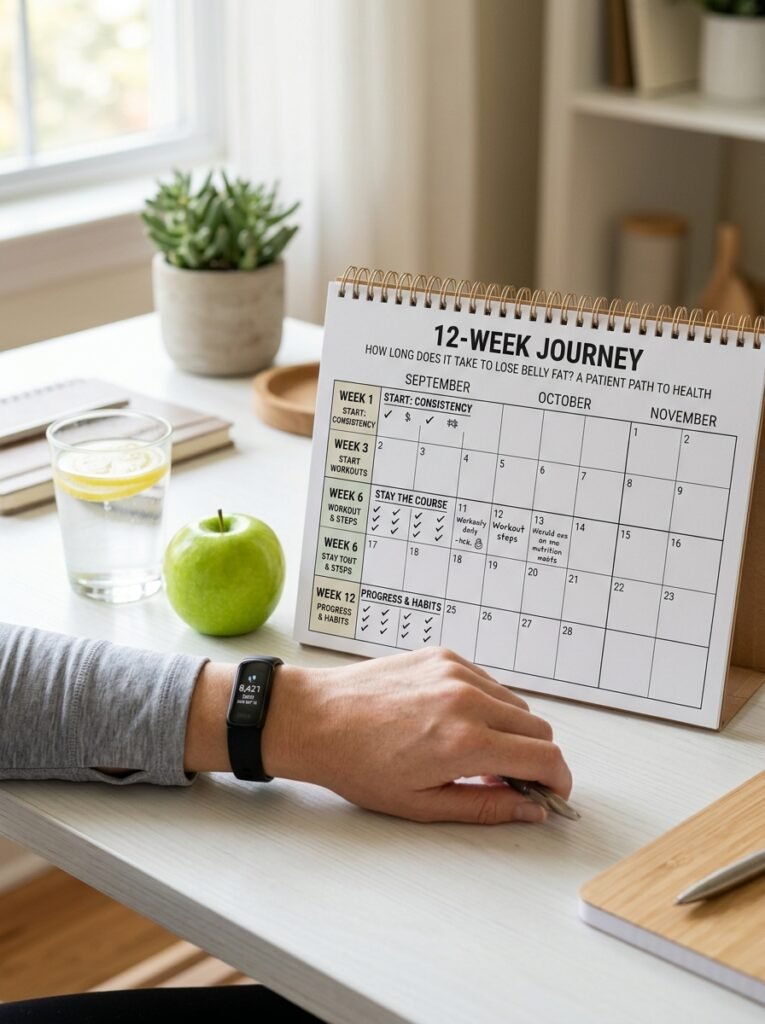
This is where patience becomes important.
You may notice changes in your energy, strength, fitness, or waist measurement before you see dramatic visual changes.
Fat loss also doesn’t happen at exactly the same rate every week.
Your weight can fluctuate because of:
- Water retention
- Food intake
- Sodium
- Hormonal changes
- Digestion
- Exercise
- Stress
- Sleep
So don’t judge your progress based on a single morning on the scale.
Look at trends over several weeks.
How to Make Your Home Workout More Effective
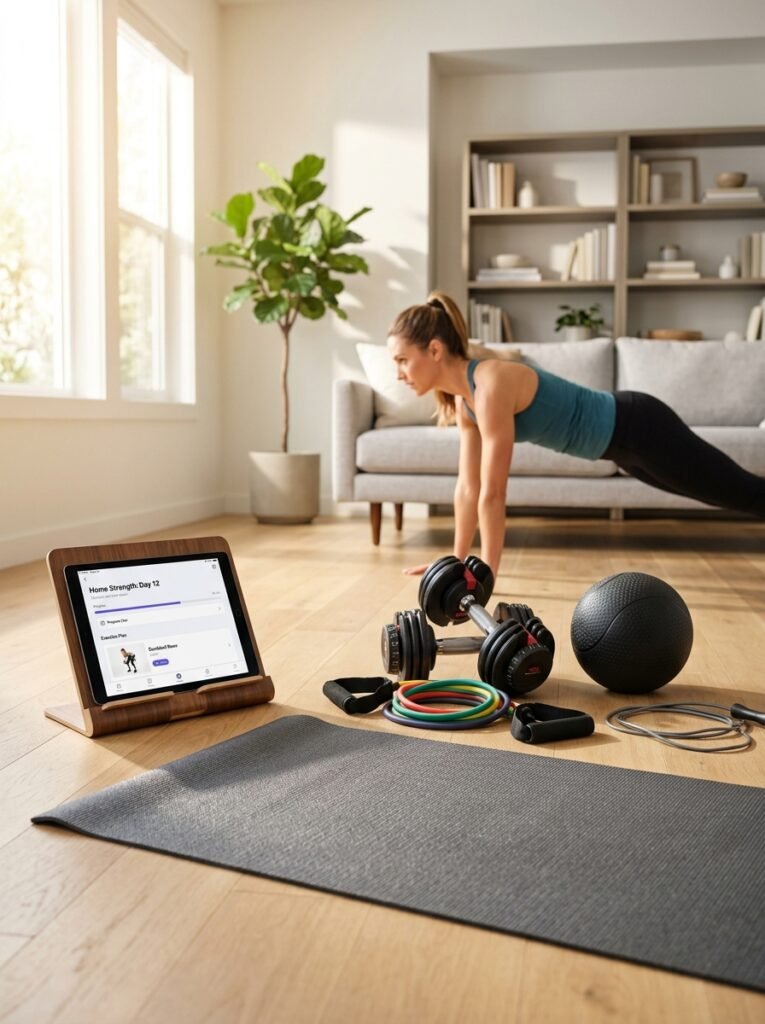
Once the workout starts feeling easy, your body needs a new challenge.
This is called progressive overload.
You don’t necessarily need heavier weights.
You can progress by:
- Adding another round
- Increasing work time
- Reducing rest slightly
- Performing more controlled repetitions
- Using resistance bands
- Adding dumbbells
- Choosing a harder variation
- Improving your exercise technique
Make small changes.
You don’t need to turn a 20-minute workout into an exhausting one-hour session.
A Simple 4-Week Progression
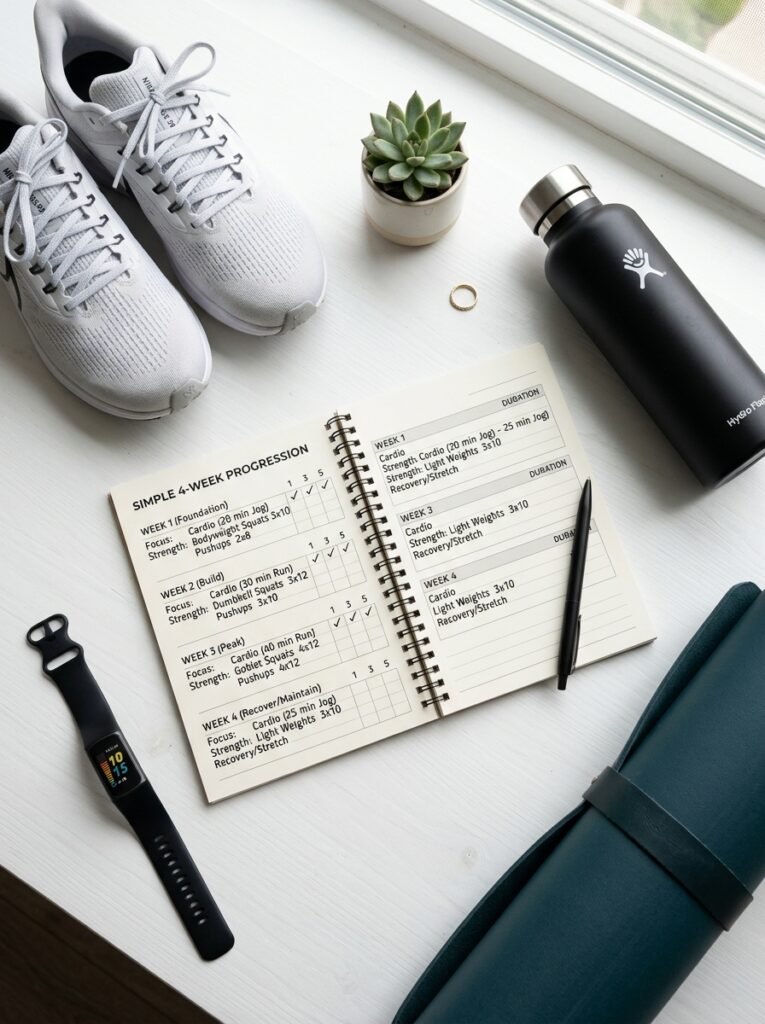
If you’re starting from scratch, here’s an easy way to build momentum.
Week 1
Complete 2 rounds of the workout three times during the week.
Focus on learning the movements.
Week 2
Continue with three workouts.
Try to improve your form and increase your work intervals slightly if you feel comfortable.
Week 3
Move toward 3 rounds during your main sessions.
Add regular walking on non-workout days.
Week 4
Continue with three or four sessions.
Choose one exercise to progress—for example, perform deeper squats, longer planks, or more controlled lunges.
This gradual approach is much easier to maintain than starting with an extremely difficult program.
Common Mistakes to Avoid
Doing hundreds of crunches
More isn’t always better.
Train your entire body and include a few quality core exercises.
Exercising too intensely
A workout that leaves you unable to move comfortably for several days isn’t necessarily a better workout.
You want something you can repeat consistently.
Expecting overnight results
Body-fat changes take time.
Give your routine several weeks before deciding whether it’s working.
Eating too little
Severely restricting food can leave you hungry, tired, and more likely to abandon your plan.
A sustainable calorie deficit is generally more practical than extreme restriction.
Ignoring sleep
Poor sleep can make healthy eating and regular exercise harder to maintain.
Aim for a consistent sleep schedule and enough sleep for your individual needs.
Only exercising when motivated
Motivation comes and goes.
A simple schedule makes it easier to keep going when motivation disappears.
What If You Have Knee or Back Problems?
Don’t push through sharp or worsening pain.
Exercise should challenge your muscles and cardiovascular system, but pain isn’t something you need to prove you can tolerate.
If a movement hurts, stop and try a gentler variation.
For persistent pain, an injury, pregnancy, or a medical condition that affects exercise, it’s a good idea to speak with a qualified healthcare professional or physical therapist before starting a new workout routine.
How to Track Progress Without Obsessing Over the Scale
The scale is only one measurement.
You can also track:
- Waist measurement
- How your clothes fit
- Number of repetitions
- Plank duration
- Walking time
- Energy levels
- Workout consistency
- Strength improvements
Take measurements under similar conditions if you choose to track them.
And remember that normal fluctuations don’t mean your efforts aren’t working.
The Biggest Secret: Consistency
If there’s one thing I’d want you to remember from this workout, it’s this:
You don’t need the perfect workout. You need a workout you can actually repeat.
Twenty minutes three or four times per week can be more useful than an intense workout you do once and never want to repeat.
Start where you are.
Make the workout easier when necessary.
Progress gradually.
And give yourself enough time to see the results of your habits.